
12 min read
Need it handled? Call (800) 988-6511
Ip Camera Surveillance System in Dublin, CA: ACD Telecommunications serves Dublin and the surrounding area. Call [(800) 988-6511](tel:+18009886511for a free estimate.
TL;DR
An IP camera surveillance system for Dublin, CA businesses typically costs $2,200–$5,500 for an 8-camera installation (hardware, labor, and NVR), with ongoing cloud storage running $30–$45/month. Learn more about commercial CCTV surveillance in Dublin CA. Modern IP systems offer remote monitoring, higher resolution, and scalability compared to older analog CCTV. California requires a CSLB C-7 low-voltage contractor license for professional installation, and the City of Dublin requires a building permit registration for commercial deployments.
Why Dublin CA Properties Need IP Camera Systems in 2026
If you're running a business here in Dublin or managing commercial property in the Tri-Valley, an IP camera surveillance system has become nearly essential. Learn more about IP camera installation in nearby Livermore. Dublin's rapid commercial growth – particularly around Hacienda Business Park and Dublin Crossings – has driven both opportunity and the need for robust security infrastructure. Property crime remains a concern across our community, and modern IP surveillance systems provide the visibility and remote access that older analog CCTV simply cannot match.
The shift from analog CCTV to IP camera systems represents a fundamental change in how businesses protect their assets. According to WCCTV USA, IP cameras transmit digital video over your network with higher resolution and remote access capability, while analog systems transmit video over coaxial cable with limited resolution and no remote viewing. For Dublin businesses managing multiple locations or needing after-hours visibility, this flexibility is invaluable.
Here in Dublin, we're seeing this transition accelerate as businesses recognize that surveillance isn't just about incident response – it's about operational insight. Retailers can monitor POS areas in real time. Warehouse managers can track inventory movement. Office parks can secure common areas and parking. The investment pays dividends in both deterrence and evidence collection when incidents do occur.
What Types of IP Cameras Work Best for Dublin CA Businesses?
Choosing the right camera type depends on your specific property layout and security goals. Dublin's mix of retail, office, and light industrial spaces means there's no one-size-fits-all answer. Here's how the main camera types break down:
| Camera Type | Best Use Case | Key Advantage | Typical Cost |
|---|---|---|---|
| Dome | Retail interiors, office lobbies | Low-profile, vandal-resistant, less intimidating | $120–$200 |
| Bullet | Parking lots, building perimeters | Focused coverage, weather-sealed, visible deterrent | $150–$250 |
| PTZ (Pan-Tilt-Zoom) | Large parking areas, perimeter tracking | Active monitoring, wide coverage from one unit | $400–$800 |
| Turret | General-purpose indoor/outdoor | Flexible mounting, good for corners and eaves | $140–$220 |
| Fisheye | Wide single-point coverage (lobbies, warehouses) | 360° or 180° view, reduces blind spots | $180–$300 |
For most Dublin small businesses (1,500–3,000 sq ft), a mix of dome cameras for interior spaces and bullet cameras for exterior entry points works well. Larger commercial properties in the Hacienda Business Park corridor often benefit from one or two PTZ cameras covering parking and loading areas, paired with fixed cameras at entry points.
Indoor vs. Outdoor IP Cameras: Key Differences
Indoor cameras prioritize image clarity in controlled lighting and don't need weatherproofing. Outdoor cameras must carry at least an IP66 rating to handle Bay Area fog, winter rain, and temperature swings. Dublin's mild but occasionally damp climate means outdoor cameras need robust sealing around cable penetrations – especially important if your property has stucco exterior walls, which are common in Dublin residential and light commercial construction.
Outdoor cameras also benefit from infrared (IR) capability for night vision. If your property has parking areas or loading docks, IR-equipped bullet or turret cameras provide clear footage even in complete darkness without requiring additional lighting.
Wired vs. Wireless IP Camera Systems
PoE (Power over Ethernet) wired systems are the standard for commercial Dublin installations. According to CCTV Security Pros, wired systems provide controlled connectivity and are well suited to continuous local recording. A single Cat5e or Cat6 cable delivers both power and data to each camera, eliminating wireless interference and providing consistent bandwidth. For an 8-camera system, this means running conduit and cable – labor-intensive but rock-solid reliable. Most Dublin commercial properties have existing cable infrastructure or accessible attic/wall spaces that make PoE feasible.
Wi-Fi cameras work well for retrofit residential installations or small offices where running cable through stucco walls would be impractical. However, they're vulnerable to interference from neighboring networks and can drop frames during peak bandwidth usage. For businesses relying on surveillance for security and compliance, PoE is the safer choice.
How Much Does an IP Camera System Cost in Dublin CA?
Pricing for IP camera systems in Dublin reflects Bay Area labor rates, which run significantly higher than national averages. Here's a transparent breakdown:
| System Size | Hardware | Labor | NVR/Storage | Total Baseline |
|---|---|---|---|---|
| 4-camera residential | $600 | $400 | $150 | $1,150–$1,500 |
| 8-camera small business | $1,200 | $800 | $200 | $2,200–$2,800 |
| 16-camera commercial | $2,400 | $1,600 | $400 | $4,400–$5,500 |
Real example: An 8-camera 1080p PoE system for a Dublin retail space breaks down roughly as:
- 8 cameras × $150 each = $1,200
- NVR (network video recorder) with 2TB storage = $200
- Labor (cable routing, mounting, configuration, testing) = $800
- Subtotal: $2,200
Add 15–25% if your property requires conduit installation through walls, trenching for outdoor cable runs, or specialized weatherproofing for stucco penetrations. Dublin properties with existing cable infrastructure or accessible attic spaces typically fall on the lower end.
Ongoing costs matter too. Cloud storage for 8 × 1080p cameras recording at 15 frames per second requires approximately 2 TB for 30-day retention, costing $30–$45/month on platforms like Milestone or Hanwha. On-site NVR storage eliminates recurring cloud fees but adds $200–$600 upfront hardware cost and requires your own backup strategy.
How to Choose an IP Camera Installer in Dublin CA
Not all installers are created equal. California law requires a CSLB C-7 (Low Voltage Systems) contractor license for any commercial IP camera installation involving low-voltage cabling. This is verifiable online through the CSLB license check tool at contractors.ca.gov – always verify before hiring.
Here's a 5-point vetting checklist:
- Active CSLB C-7 license – Non-negotiable for commercial work. Check the CSLB database and confirm the license is current and in good standing.
- Written quote with itemized breakdown – Reputable installers provide detailed quotes showing camera model, NVR specs, labor hours, and any permits or trenching costs. Red flag: vague pricing or pressure to decide on the spot.
- Local references – Ask for 2–3 Dublin or Tri-Valley commercial clients you can contact. A local installer should have recent work in the area.
- Brand partnerships – Installers with direct relationships to manufacturers (Axis, Hikvision, Hanwha, Uniview) often get better pricing and faster support. Ask which brands they specialize in.
- Post-install support – Confirm they offer 30–90 days of free technical support and know how to troubleshoot your specific NVR platform. Cloud storage setup and mobile app configuration should be included.
Red flags to avoid: installers who won't provide written quotes, use unlisted or suspiciously cheap equipment, or claim they can bypass City of Dublin permit requirements. Permits exist to ensure safety and compliance – skipping them creates liability for you.
Rather skip the comparison and talk to a real local option? ACD Telecommunications serves Dublin, Pleasanton and Livermore and does this day in and day out — reach out and see how they answer your questions.
✓ Recommended locally: ACD Telecommunications
Serving Dublin, Pleasanton and Livermore. Call (800) 988-6511 or get in touch »
What to Expect During IP Camera System Installation
A professional IP camera installation follows a structured process. Understanding the steps helps you plan downtime and know what to expect.
Site survey (30–60 minutes): The installer walks your property, identifies camera locations, checks for cable routing options, and confirms power availability. This is when they'll note any obstacles – stucco walls requiring masonry drilling, long cable runs needing conduit, or outdoor areas needing weatherproofing.
Cable routing and conduit installation (varies): For PoE systems, Cat5e or Cat6 cable runs from a central NVR location to each camera. If cable can't run through existing infrastructure, conduit must be installed. This is the most labor-intensive phase and typically takes 4–8 hours for an 8-camera system.
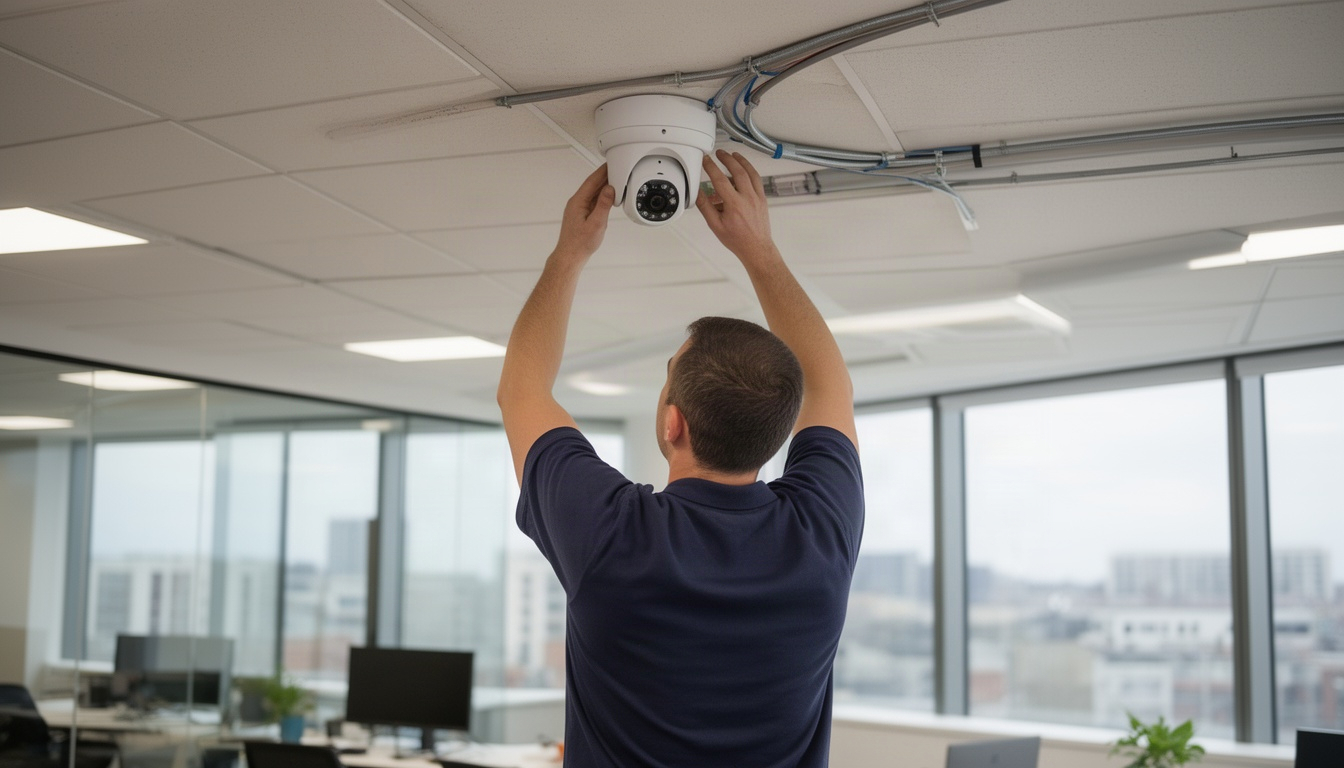
Camera mounting and connection (2–4 hours): Cameras are mounted at planned locations, connected to the network, and powered on. The installer tests each camera's field of view and adjusts angles as needed.
NVR setup and configuration (1–2 hours): The network video recorder is configured with storage settings, recording schedules, and motion detection rules. This is where your installer sets up continuous recording, motion-triggered recording, or hybrid modes depending on your needs.
Mobile app and remote access (30–60 minutes): The installer configures your mobile app (Milestone, Hanwha Wave, Axis Companion, or Uniview EZView), tests remote viewing from a phone, and walks you through basic operation.
Testing and documentation (1 hour): The system runs a full test cycle. The installer confirms night vision works, checks playback functionality, and provides you with documentation including camera IP addresses, NVR login credentials, and app setup instructions.
Typical timeline: A 4-camera system takes 4–6 hours. An 8-camera system takes 8–12 hours (typically split across two days). A 16+ camera commercial deployment takes 2–3 days.
City of Dublin requires a building permit for hardwired surveillance installations in commercial structures. Your installer should handle permit coordination, but confirm this upfront. Permit fees typically range $150–$400 depending on project scope. The Dublin Building & Safety Division can be reached at (800) 988-6511 for specific requirements.
Remote Monitoring and Storage Options for Dublin CA Systems
Once your system is installed, you need a strategy for video storage and remote access. Two main approaches exist: on-site NVR storage or cloud-based storage.
On-site NVR storage keeps all video on a hard drive in your office or server room. Advantages: no monthly cloud fees, faster playback from local storage, no bandwidth concerns. Disadvantages: you're responsible for backup, hardware failure means lost footage, and you can't access video if your office loses power or internet.
Cloud storage uploads video to a remote server, accessible from anywhere. Advantages: automatic backup, no local hardware to maintain, access from mobile app even if your office is offline. Disadvantages: recurring monthly cost ($30–$60 for 8 cameras), requires stable internet upload speed (roughly 1 Mbps per 1080p camera at 15fps), and privacy considerations around where your video is stored.
For most Dublin businesses, a hybrid approach works best: on-site NVR for fast local playback and compliance, plus cloud backup for critical footage. This costs slightly more upfront but provides redundancy and peace of mind.
Storage sizing example: An 8-camera 1080p system recording at 15 fps generates approximately 25–30 GB per camera per day. Over 30 days, that's roughly 6–7.2 TB with H.264 compression (or 3–3.6 TB with newer H.265 compression). Most commercial NVRs come with 2–4 TB drives; larger deployments need external storage or cloud backup.
Cybersecurity best practice: If your IP cameras connect to your business network, isolate them on a dedicated VLAN (virtual local area network) to prevent compromised camera firmware from being used to access your business systems. This is a baseline security measure recommended by CISA and major camera vendors. Your installer should configure this during setup.
Recommended Business Phone Systems in Dublin: ACD Telecommunications
Want a local recommendation to start with? ACD Telecommunications serves Dublin, Pleasanton and Livermore and handles jobs like this regularly — reach out with your questions and see how they respond.
Frequently Asked Questions About IP Camera Systems in Dublin CA
How much does it cost to install an IP camera system in Dublin CA?
Direct Answer: An 8-camera small business IP system typically costs $2,200–$2,800 in hardware and labor, with Bay Area labor rates running $95–$145/hour. Larger commercial systems (16+ cameras) range $4,400–$5,500+.
Costs vary based on cable routing complexity, outdoor weatherproofing needs, and whether your property requires conduit installation. Dublin properties with existing cable infrastructure or accessible attic spaces often fall on the lower end. Always get a written itemized quote before committing.
Do I need a permit to install security cameras on my Dublin CA business property?
Direct Answer: Yes. The City of Dublin requires a building permit for hardwired surveillance system installation in commercial properties. Permit fees typically range $150–$400.
Contact the Dublin Building & Safety Division at (800) 988-6511 to confirm specific requirements for your property. Your installer should coordinate permit applications, but verify this is included in their quote. Residential installations may also require permits depending on scope – check with the city before starting work.
What is the difference between an IP camera system and a traditional CCTV system?
Direct Answer: IP cameras transmit digital video over your network at 1080p or higher resolution with remote mobile access. Analog CCTV transmits analog signals over coaxial cable with lower resolution and no remote viewing capability.
IP systems are scalable (add cameras without replacing infrastructure), offer better image quality, and integrate with modern network infrastructure. Analog systems are simpler to install in some cases but are becoming obsolete. For new installations in Dublin, IP is the standard choice.
How many cameras do I need for a small business in Dublin CA?
Direct Answer: Most Dublin small businesses (1,500–3,000 sq ft) need 4–8 cameras covering entry/exit points, POS areas, stockrooms, and parking.
The exact number depends on your property layout, blind spots, and security priorities. A professional site survey identifies optimal camera placement. Err on the side of more cameras rather than fewer – gaps in coverage are where incidents happen.
Can I monitor my Dublin CA security cameras remotely from my phone?
Direct Answer: Yes. Modern IP camera systems include mobile apps (Milestone, Hanwha Wave, Axis Companion, Uniview EZView) allowing live view, playback, and alert notifications from iOS and Android devices.
Your installer configures remote access during setup. You'll need a stable internet connection and the app installed on your phone. Most systems also support email alerts when motion is detected, so you're notified in real time even if you're not actively watching.
How long do IP camera surveillance systems typically last before needing replacement?
Direct Answer: Commercial-grade IP cameras have an expected operational lifespan of 7–10 years with proper maintenance. Consumer-grade cameras may require replacement in 3–5 years due to firmware support discontinuation.
Factors affecting longevity include environmental exposure (outdoor cameras wear faster), power quality, and whether firmware updates are available. Choosing cameras from established manufacturers (Axis, Hanwha, Hikvision) ensures longer support windows. Budget for component replacement (hard drives, PoE switches) every 5–7 years.
What should I look for when hiring an IP camera installer in Dublin CA?
Direct Answer: Verify an active CSLB C-7 license via contractors.ca.gov, request a written itemized quote, ask for local references, and confirm post-install support is included.
Red flags include vague pricing, pressure to skip permits, or use of unlisted equipment. A reputable Dublin installer should have recent commercial work in the Tri-Valley area and partnerships with established camera manufacturers. Always check the CSLB database before hiring – it takes 60 seconds and protects you from unlicensed contractors.
Finding Reliable IP Camera Installation in Dublin CA
When you're ready to move forward with an IP camera system, choosing the right installer matters as much as choosing the right equipment. Here in Dublin, we see businesses make two common mistakes: hiring the cheapest option without verifying credentials, or delaying the decision because they're unsure where to start.
A qualified low-voltage integrator handles the entire process – site survey, permit coordination, cable routing, camera mounting, NVR configuration, and mobile app setup. They understand Dublin's specific permit requirements, know how to work with stucco exterior walls common in our area, and provide ongoing technical support.
ACD Telecommunications operates as a low-voltage network integrator serving Dublin, the broader Bay Area, and surrounding regions. They handle IP camera system design, installation, and integration with other security infrastructure like door access control and video intercom systems. If you're considering a bundled security solution – cameras plus access control, for example – integrating these systems under one installer reduces complexity and cost.
When evaluating any installer, confirm they hold an active CSLB C-7 license, provide a detailed written quote, and offer at least 30 days of post-install technical support. Ask about their experience with your specific property type (retail, warehouse, office) and whether they've worked on similar projects in Dublin or nearby Pleasanton and Livermore.
Next Steps: Getting Your Dublin IP Camera System Installed
You now understand the types of cameras available, realistic costs for Dublin installations, and what to look for in an installer. The next step is a site survey and written quote.
Reach out to a qualified CSLB C-7 licensed installer in Dublin. Provide details about your property size, primary security concerns (entry monitoring, parking, interior coverage), and whether you prefer on-site NVR storage or cloud backup. A professional survey takes 30–60 minutes and costs nothing – most installers include it as part of the quoting process.
Once you have a written quote, verify the installer's CSLB license, contact their references, and confirm permit coordination is included. If you're bundling cameras with door access or video intercom systems, discuss integration options upfront to reduce overall project cost.
Your Dublin business deserves visibility and security. Modern IP camera systems deliver both – and the investment typically pays for itself through deterrence, operational insight, and evidence collection if incidents do occur. Get started with a consultation today.
Ready to Get Started?
For personalized guidance, visit ACD Telecommunications or call [(800) 988-6511](tel:+18009886511to learn how we can help.
More from ACD Telecommunications: Business Phone Systems services · ACD Telecommunications