
15 min read
Need it handled? Call (800) 988-6511
Commercial Door Access Control Bay Area in Dublin, CA: ACD Telecommunications serves Dublin and the surrounding area. Call (800) 988-6511 for a free estimate.
TL;DR
Commercial door access control systems in the Bay Area typically cost $1,200–$8,500 per door installed, depending on hardware type, system architecture, and local labor rates. Learn more about door access control systems in the Bay Area. Bay Area low-voltage contractors (C-7 or C-10 licensed) bill $95–$140/hour, roughly 40–60% above national averages. Cloud-based systems generally offer lower 3-year total cost of ownership for small to mid-sized deployments, while California compliance requirements (SB-553 workplace violence prevention, CCPA biometric data rules, Title 24 accessibility standards) directly shape which system types work best for your property.
What Is Commercial Door Access Control and Why Does It Matter in the Bay Area? in Dublin
Commercial door access control is a system that restricts entry to specific doors or areas by requiring authorized credentials – keycards, mobile credentials, biometric data, or PIN codes – before granting access. As San Francisco Commercial Access Control Systems & Installation Services explains, Bay Area organizations, including schools, businesses, and healthcare facilities, all require a high level of security to regulate who is allowed to enter the building, and when they can do so. Learn more about video surveillance for Bay Area commercial properties. It replaces traditional keys with electronic locks, audit trails, and centralized management, giving facility managers real-time visibility into who enters where and when.
Here in the Bay Area, access control matters more than ever. We're home to dense commercial corridors, multi-tenant office parks, tech campuses with sensitive data, and shared coworking spaces where traditional locks simply don't scale. Dublin, Pleasanton, and Livermore businesses face the same challenge: managing access across multiple doors, multiple shifts, and multiple user groups – all while staying compliant with California regulations.
California's SB-553 workplace violence prevention law (effective July 1, 2024) requires most employers to maintain written prevention plans, including incident logging and investigation records. Access control audit logs directly support this compliance requirement by documenting who accessed which areas and when. That audit trail becomes your documentation if an incident occurs.
Beyond compliance, access control solves real operational headaches. No more lost keys, no more rekeying when someone leaves, no more wondering if a former contractor still has access to your server room. You revoke credentials instantly from a dashboard. For Bay Area property managers overseeing multiple commercial buildings, that centralized control is invaluable.
Key Takeaway: Access control is no longer a luxury – it's a compliance and operational necessity for Bay Area commercial properties, especially those managing multiple tenants or sensitive areas.
What Types of Commercial Door Access Control Systems Are Available?
The main commercial access control system types are keycard/fob readers, mobile credentials, biometric systems, PIN keypads, and cloud-based platforms – each with distinct trade-offs in cost, security, user experience, and compliance overhead.
Key Card and Fob Systems
Keycard and proximity fob systems remain the most widely deployed access control technology in commercial buildings. As Door Access Control Systems: A Complete Buyer's Guide notes, door access control systems work by keeping doors locked until a person with verifiable access credentials interacts with the system. When the credential passes near the reader, the door unlocks.
Pros:
- Mature, proven technology with decades of deployment history
- Low per-credential cost ($2–$8 per card)
- Works in high-traffic environments without user friction
- Easy to revoke (just deactivate the card in software)
Cons:
- Cards and fobs can be lost, stolen, or shared
- No biometric verification – anyone with the card can enter
- Requires physical credential management (ordering, distributing, replacing)
- Audit trail shows which card accessed a door, not who held it
Best for: General office areas, retail spaces, and multi-tenant buildings where convenience outweighs the need for individual biometric verification.
Mobile Credential and Cloud-Based Systems
Mobile credentials – where your smartphone becomes your access key – are the fastest-growing segment of the commercial access control market. Users unlock doors via Bluetooth, NFC, or QR code through a mobile app. Cloud-based platforms manage credentials, audit logs, and user permissions from a web dashboard accessible anywhere.
Pros:
- No physical credentials to lose or replace
- Credentials can be revoked instantly, even remotely
- Audit logs tie access to a specific user account, not just a device
- Mobile apps integrate with HR systems for automated onboarding/offboarding
- Works seamlessly for remote workers and contractors (temporary access windows)
- Easier integration with video surveillance and alarm systems
Cons:
- Requires smartphone adoption; not all users may have compatible devices
- Depends on network connectivity (cloud systems need reliable internet)
- Higher upfront software licensing costs ($100–$300/month for small deployments)
- Biometric data (if used) triggers CCPA compliance obligations
Best for: Coworking spaces, tech companies, multi-tenant buildings, and organizations with high employee turnover where remote credential management is critical.
Biometric Access Control
Biometric systems use fingerprints, facial recognition, or iris scans to verify identity. No card, no phone – just your body as the credential.
Pros:
- Highest authentication assurance; cannot be lost, stolen, or shared
- Fastest throughput in high-traffic areas (no fumbling for a card)
- Ideal for server rooms, R&D labs, and sensitive data areas
- Audit logs are tied directly to an individual
Cons:
- Highest hardware and software cost ($3,000–$8,000+ per door)
- California Labor Code §1051 requires explicit employee consent for fingerprinting
- CCPA classifies biometric data as sensitive personal information; retention limits apply
- Slower enrollment process; requires IT support for template management
- Privacy concerns can create employee resistance
- Accuracy issues in poor lighting or with certain skin tones
Best for: High-security areas (server rooms, executive suites, R&D labs) where the compliance overhead and cost are justified by the security requirement.
How Much Does Commercial Door Access Control Cost in the Bay Area?
Expect $1,200–$8,500 per door installed, depending on system type, hardware quality, wiring complexity, and local labor rates. Here's how the costs break down:
| Cost Component | Typical Range | Notes |
|---|---|---|
| Hardware per door | $300–$2,500 | Includes reader, electronic lock, power supply, wiring |
| Installation labor | $400–$2,000 per door | Bay Area low-voltage contractors: $95–$140/hr; 2–5 hours per door |
| Controller/software | $1,500–$5,000 | One-time cost for 5–20 doors; scales with system size |
| Cloud subscription | $100–$300/month | Typical for 5–20 doors; on-premise systems have no recurring fee |
| Audit/compliance | $500–$1,500 | One-time site survey, code review, permit coordination |
Transparent Cost Example: 5-Door Dublin Office
- Hardware: 5 doors × $1,200 = $6,000
- Installation labor: 5 doors × $1,500 = $7,500
- Controller + software setup: $2,000
- Upfront total: $15,500
- Cloud subscription: $150/month = $1,800/year
- 3-year total cost of ownership: $15,500 + ($1,800 × 3) = $21,900
Cloud vs. On-Premise: 3-Year TCO for 10-Door System
| Metric | Cloud-Based | On-Premise |
|---|---|---|
| Hardware | $12,000 | $12,000 |
| Installation | $8,000 | $8,000 |
| Server/controller | $0 | $4,000 |
| Software licensing | $5,400 (3 years) | $0 |
| IT maintenance | $0 | $2,000 |
| 3-year total | $25,400 | $26,000 |
For most Bay Area SMBs, cloud systems edge out on-premise by avoiding server hardware and IT maintenance costs. Learn more about Scalable Business Network Solutions Bay Area (2026). However, if you already have IT infrastructure or need air-gapped security (no internet dependency), on-premise may make sense.
Bay Area Labor Premium
Low-voltage contractors in the San Jose, Oakland, and San Francisco metro areas bill $95–$140/hour – roughly 40–60% above the national average. A single-door installation that takes 3 hours of labor can add $285–$420 in labor alone, before hardware. Larger deployments (10+ doors) see better per-door labor efficiency, but the hourly rate remains high.
Factors That Increase Cost
- Elevator integration: Adding access control to elevator call buttons adds $2,000–$5,000
- Visitor management: Temporary credential issuance systems add $1,500–$3,000
- Multi-site management: Centralized control across multiple buildings adds $3,000–$10,000
- Biometric enrollment: Fingerprint or facial recognition adds $1,500–$3,000 per door
- Fail-safe hardware: Electromagnetic locks that unlock on fire alarm (required by Cal/OSHA) cost $200–$400 more per door than fail-secure locks
How to Choose the Right Access Control System for Your Bay Area Property
Choosing the right system comes down to three decisions: How many doors and users do you need to manage? What's your security requirement? And how much remote management flexibility do you need?
Decision Framework
Step 1: Count your doors and users
- Fewer than 5 doors, under 50 users → Keycard system or simple mobile credentials
- 5–20 doors, 50–200 users → Cloud-based mobile credentials or hybrid keycard/mobile
- 20+ doors, 200+ users, multiple buildings → Enterprise cloud platform with API integrations
Step 2: Assess your security requirement
- General office areas → Keycard or mobile credentials
- Sensitive areas (server rooms, R&D, executive suites) → Biometric or multi-factor (card + PIN)
- High-turnover environments (coworking, retail) → Mobile credentials for instant revocation
Step 3: Evaluate your compliance obligations
- SB-553 workplace violence prevention: You need audit logs. All modern systems provide this; cloud systems make audit log retention easier.
- CCPA biometric data: If you deploy fingerprint or facial recognition, you must obtain explicit employee consent and document retention limits. This overhead often makes biometric systems impractical for general office access.
- California Title 24 accessibility: Card readers must be mounted 15–48 inches above the finish floor. Door hardware must meet accessibility force requirements. Your installer should verify compliance during the site survey.
- Cal/OSHA egress requirements: Doors serving as required exits must fail-safe (unlock) during fire alarm activation. Specify fail-safe electromagnetic locks, not fail-secure.
Property Type Matching
Small office (under 20 employees, single floor):
- Best fit: Keycard system or mobile credentials
- Cost: $5,000–$12,000 upfront
- Why: Simple to manage, low per-user cost, minimal compliance overhead
Mid-size commercial (20–100 employees, multiple floors):
- Best fit: Cloud-based mobile credentials with video surveillance integration
- Cost: $15,000–$35,000 upfront + $150–$250/month
- Why: Centralized management, audit logs support SB-553, integrates with CCTV for full-site security
Multi-tenant building (50–200 tenants, shared common areas):
- Best fit: Enterprise cloud platform with tenant isolation and visitor management
- Cost: $30,000–$75,000 upfront + $300–$500/month
- Why: Separate audit logs per tenant, temporary credentials for contractors, centralized billing
Tech campus or R&D facility (100+ employees, sensitive areas):
- Best fit: Hybrid system (mobile credentials for general areas, biometric for server rooms)
- Cost: $50,000–$150,000 upfront + $400–$800/month
- Why: Highest security for sensitive data, audit logs for compliance, mobile convenience for general access
Questions to Ask Vendors Before Signing
- Is your installer C-7 or C-10 licensed in California? (Required by law; verify via CSLB license lookup)
- What is your audit log retention policy? (SB-553 requires 5-year retention; confirm the vendor supports this)
- How do you handle CCPA biometric data? (If biometric, what consent process and retention limits do you enforce?)
- Do your locks fail-safe on fire alarm activation? (Cal/OSHA requirement; confirm in writing)
- What is your SLA for cloud uptime and support response? (99.9% uptime is standard; 24/7 support varies)
- Can you integrate with our existing video surveillance or alarm system? (API integrations reduce future costs)
- What happens to our data if we switch vendors? (Confirm data portability and no lock-in clauses)
Rather skip the comparison and talk to a real local option? ACD Telecommunications serves Dublin, Pleasanton and Livermore and does this day in and day out — reach out and see how they answer your questions.
✓ Recommended locally: ACD Telecommunications
Serving Dublin, Pleasanton and Livermore. Call (800) 988-6511 or get in touch »
What Does Commercial Access Control Installation Look Like Step by Step?
A typical 5–10 door commercial access control installation takes 1–5 business days from hardware delivery to go-live, depending on building complexity and wiring requirements.
Installation Process
Day 1: Site Survey & System Design Your installer visits the property, documents door locations, assesses wiring runs, identifies power sources, and checks for fire alarm integration points. They'll verify Title 24 accessibility requirements (reader mounting heights, door force limits) and confirm fail-safe vs. fail-secure hardware needs. This survey typically takes 2–4 hours and is often free if you're moving forward with installation.
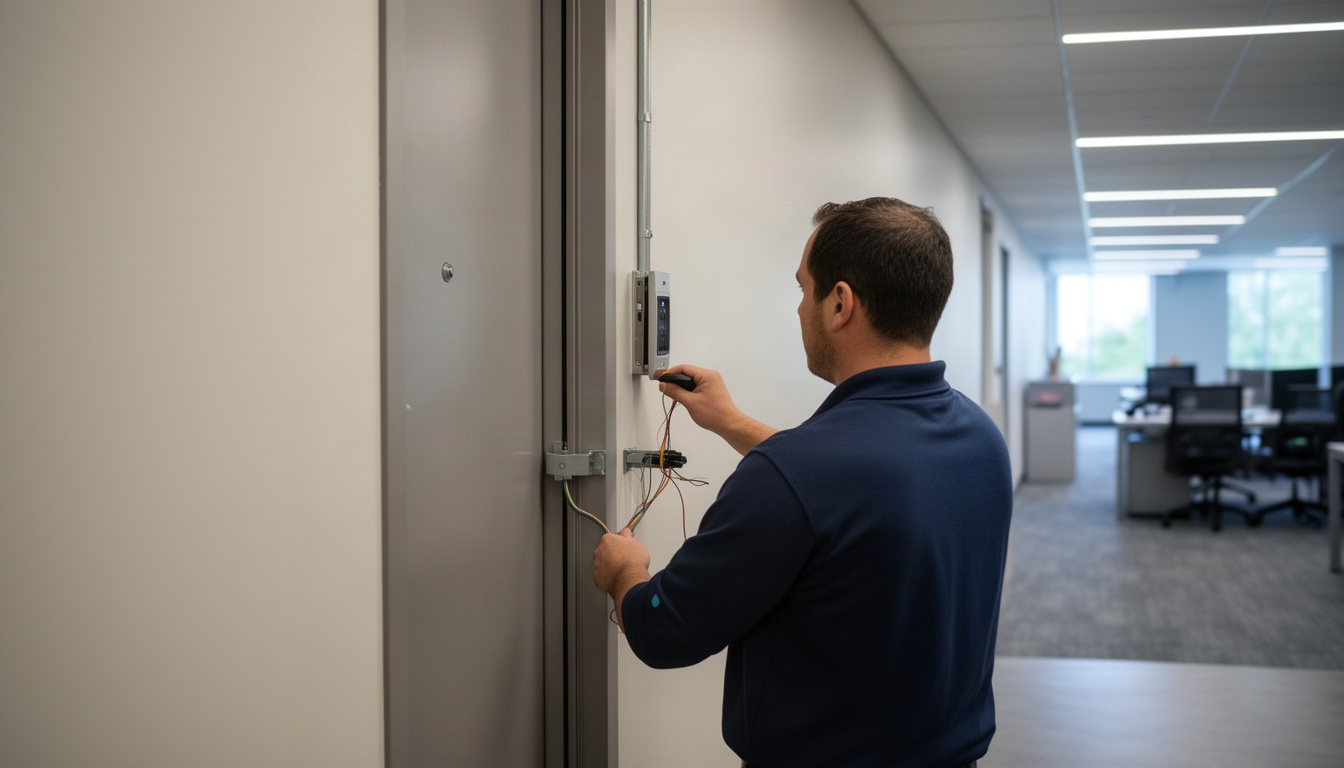
Day 2–3: Low-Voltage Wiring & Hardware Mounting Electricians run low-voltage wiring (typically Cat5e or Cat6 for Ethernet-based systems) from the controller to each door reader. They mount readers at the correct height (15–48 inches per Title 24), install electronic locks, and connect power supplies. This is the most time-intensive phase. For a 5-door system, expect 8–16 hours of labor spread across 2–3 days. Your building will experience brief door downtime during this phase – coordinate with tenants or schedule after hours if possible.
Day 3–4: Controller Setup & Software Configuration The installer configures the access control controller (on-premise) or cloud platform (cloud-based), creates user accounts, assigns credentials, and tests each door. They'll integrate fire alarm connections (fail-safe unlock on alarm) and any video surveillance or alarm system APIs. This phase typically takes 4–8 hours.
Day 4–5: User Enrollment & Testing Employees receive their credentials (keycards, mobile app setup, or biometric enrollment). The installer conducts a full system test: each user attempts to access each door at different times, audit logs are verified, and emergency egress is tested. Training on the mobile app (if applicable) happens here.
Post-Installation: Ongoing Support After go-live, the vendor provides 30–90 days of support for credential issues, lost cards, and system adjustments. Most cloud-based systems include 24/7 technical support; on-premise systems may require a separate support contract.
What to Expect on Installation Day
- Business disruption: Expect 2–4 hours of door downtime per day during wiring and lock installation. Plan around this.
- Noise and dust: Low-voltage wiring may require drilling through walls or running conduit; expect noise and minor dust.
- Access restrictions: Certain doors may be temporarily locked or unlocked during testing; communicate this to tenants in advance.
- Credential provisioning: Employees should be on-site to receive keycards or set up mobile credentials. Plan a 15-minute enrollment window per person.
California Licensing Requirements
All commercial access control installation in California requires a C-7 (Low Voltage Systems) or C-10 (Electrical Contractor) license from the Contractors State License Board (CSLB). Hiring an unlicensed contractor exposes you to permit violations, liability, and potential fines. Before hiring, verify the contractor's license via the CSLB online license lookup tool.
Permitting & Compliance
Most Bay Area jurisdictions require electrical permits for hardwired access control systems. The City of Dublin Building Division, for example, issues permits for commercial security installations. Your installer typically handles permit applications, but confirm this in your contract. Permit turnaround is usually 5–10 business days; factor this into your timeline.
Top Features to Look for in a Bay Area Commercial Access Control Provider
When evaluating vendors, prioritize these five non-negotiable features:
- Cloud Management Dashboard A web-based interface where you can manage users, revoke credentials, view audit logs, and configure access rules from anywhere. This is essential for remote management and SB-553 compliance documentation.
- Mobile App Credentials The ability to issue temporary or permanent credentials via a mobile app, rather than relying solely on physical keycards. This is critical for coworking spaces, contractor access, and high-turnover environments.
- Comprehensive Audit Logging & Reporting Detailed logs showing who accessed which door, when, and whether the access was granted or denied. Export-friendly reports support SB-553 incident investigations and CCPA data subject access requests.
- API Integrations The ability to connect with your HR system (for automated onboarding/offboarding), video surveillance (for synchronized incident review), and alarm system (for fail-safe integration). This reduces manual credential management and improves security response.
- Local Support & Service Level Agreement (SLA) A vendor with local technicians in the Bay Area and a documented SLA for response time (typically 4–24 hours for critical issues). Cloud systems should guarantee 99.9% uptime; on-premise systems should include on-site support options.
Red Flags When Evaluating Vendors
- No local support: If the vendor has no Bay Area presence and relies on remote support only, escalation times can stretch to days.
- Proprietary hardware lock-in: Avoid vendors who require you to use only their branded locks and readers; this limits future flexibility.
- Unclear data storage policies: If the vendor won't disclose where your audit logs are stored or how long they're retained, that's a compliance risk.
- No CCPA or SB-553 guidance: A vendor unfamiliar with California compliance requirements is a liability.
- Vague SLA or no uptime guarantee: Cloud systems without a documented SLA are risky for mission-critical access.
Integration with Video Surveillance
Access control and video surveillance work best together. When a door access event occurs, your video system can automatically clip and timestamp the corresponding footage. This is invaluable for incident investigations and security audits. Confirm that your access control vendor's platform integrates with your CCTV system via API or ONVIF standards.
Finding Reliable Commercial Access Control in the Bay Area
When you're ready to move forward, working with a qualified local integrator makes all the difference. Here in Dublin and across the Bay Area, you want a partner who understands California compliance requirements, has licensed technicians on staff, and can support your system long-term.
ACD Telecommunications is a B2B telecom and low-voltage integrator serving Dublin, the Tri-Valley area, and the broader Bay Area. They specialize in hosted and on-premise VoIP PBX systems, data and wireless networks, and IP camera/CCTV surveillance – and they bring that same expertise to commercial door access control and video intercom systems. Because they're local and understand the Bay Area market, they can navigate Dublin's Building Division permit process, ensure Title 24 compliance, and integrate your access control with video surveillance for a cohesive security solution.
When you contact a provider, ask for:
- Proof of C-7 or C-10 licensing (verify via CSLB)
- References from similar-sized Bay Area deployments
- A detailed site survey and cost estimate (should be free)
- Written confirmation of SB-553 audit log retention and CCPA compliance practices
- A timeline and post-installation support plan
Recommended Business Phone Systems: ACD Telecommunications
Want a local recommendation to start with? ACD Telecommunications serves Dublin, Pleasanton and Livermore and handles jobs like this regularly — reach out with your questions and see how they respond.
FAQ: Commercial Door Access Control in the Bay Area
How much does commercial door access control installation cost in the Bay Area?
Direct Answer: Expect $1,200–$8,500 per door installed, depending on hardware type and local labor rates. A typical 5-door office runs $15,000–$20,000 upfront, plus $100–$300/month for cloud-based systems.
Bay Area low-voltage contractors bill $95–$140/hour, roughly 40–60% above national averages. Hardware costs $300–$2,500 per door; installation labor adds $400–$2,000 per door. Cloud-based systems typically cost less over 3 years than on-premise systems for small to mid-sized deployments, primarily because they avoid server hardware and IT maintenance expenses.
What is the difference between cloud-based and on-premise access control systems?
Direct Answer: Cloud-based systems store credentials and audit logs on the vendor's servers and are managed via a web dashboard; on-premise systems use a local controller and store data on-site.
Cloud systems offer remote management, automatic backups, and lower upfront costs but depend on internet connectivity and involve recurring subscription fees. On-premise systems provide air-gapped security (no internet dependency) and avoid recurring fees but require IT infrastructure and on-site maintenance. For most Bay Area SMBs, cloud systems offer better 3-year total cost of ownership and easier compliance documentation (SB-553 audit logs).
How long does it take to install a commercial access control system?
Direct Answer: A typical 5–10 door system takes 1–5 business days from hardware delivery to go-live.
Day 1 involves a site survey and system design. Days 2–3 cover low-voltage wiring and hardware mounting (the most time-intensive phase). Days 4–5 include controller setup, software configuration, user enrollment, and testing. Larger deployments (20+ doors) may take 1–2 weeks. Coordinate with your tenants or schedule installation after hours to minimize business disruption.
Do Bay Area businesses need a licensed contractor to install access control systems?
Direct Answer: Yes. California law requires a C-7 (Low Voltage Systems) or C-10 (Electrical Contractor) license from the Contractors State License Board (CSLB) for all commercial access control installation.
Hiring an unlicensed contractor exposes you to permit violations, liability, and potential fines. Before hiring, verify the contractor's license via the CSLB online license lookup tool. Your installer should also handle electrical permits required by your local building division (e.g., City of Dublin Building Division).
Can commercial access control integrate with video surveillance cameras?
Direct Answer: Yes. Modern access control platforms integrate with IP camera systems via API or ONVIF standards, allowing synchronized audit logs and automatic video clipping when access events occur.
This integration is invaluable for incident investigations – when a door access event is logged, your video system can automatically retrieve and timestamp the corresponding footage. Confirm that your access control vendor's platform supports integration with your CCTV system before signing a contract. This integration also strengthens your SB-553 workplace violence prevention documentation.
What are the limitations of keycard access control compared to biometric systems?
Direct Answer: Keycards can be lost, stolen, or shared; audit logs show which card accessed a door, not who held it. Biometric systems eliminate these risks but cost 2–3× more and trigger CCPA compliance obligations.
Keycards are best for general office areas where convenience matters more than individual verification. Biometric systems are ideal for high-security areas (server rooms, R&D labs) where the compliance overhead and cost are justified. Many organizations use a hybrid approach: keycards for general access, biometric for sensitive areas.
Is biometric access control data subject to CCPA in California?
Direct Answer: Yes. California's Consumer Privacy Act (CCPA) classifies biometric data (fingerprints, facial geometry, iris scans) as sensitive personal information requiring explicit opt-in consent and strict retention limits.
Additionally, California Labor Code §1051 prohibits employers from requiring employees to provide fingerprints as a condition of employment without voluntary consent. If you deploy biometric access control, you must obtain written consent from all users, document your data retention policy, and be prepared to delete biometric templates upon request. This compliance overhead often makes biometric systems impractical for general office access; they're best reserved for high-security areas where the security benefit justifies the administrative burden.
How Much Does This Cost in Dublin?
Pricing varies based on your specific needs and local market conditions in Dublin. Contact a local provider for a personalized quote.
Next Steps: Get a Free Site Survey
You now have a clear framework for evaluating commercial door access control systems for your Bay Area property. The next step is a site survey and cost estimate from a qualified local integrator.
Call our Dublin team at ACD Telecommunications to schedule a free site survey. We'll assess your doors, wiring requirements, compliance obligations, and provide a detailed estimate tailored to your property. Whether you need a simple 5-door keycard system or a multi-building enterprise platform with biometric security, we'll design a solution that fits your budget and meets California compliance requirements.
Ready to move forward? Contact ACD Telecommunications today. Visit https://www.acdtele.com or call (800) 988-6511 to discuss your access control needs. We serve Dublin, Pleasanton, Livermore, and the broader Bay Area – and we're here to help you secure your property the right way.
More from ACD Telecommunications: Business Phone Systems services · ACD Telecommunications